Heating Troubleshooting
Furnace Not Turning On in Brooklyn — Common Causes & What to Notice
A gas furnace that won't fire up can stop at several points in its startup sequence. Here's what you can safely notice before calling and how those symptoms help a technician diagnose the system.
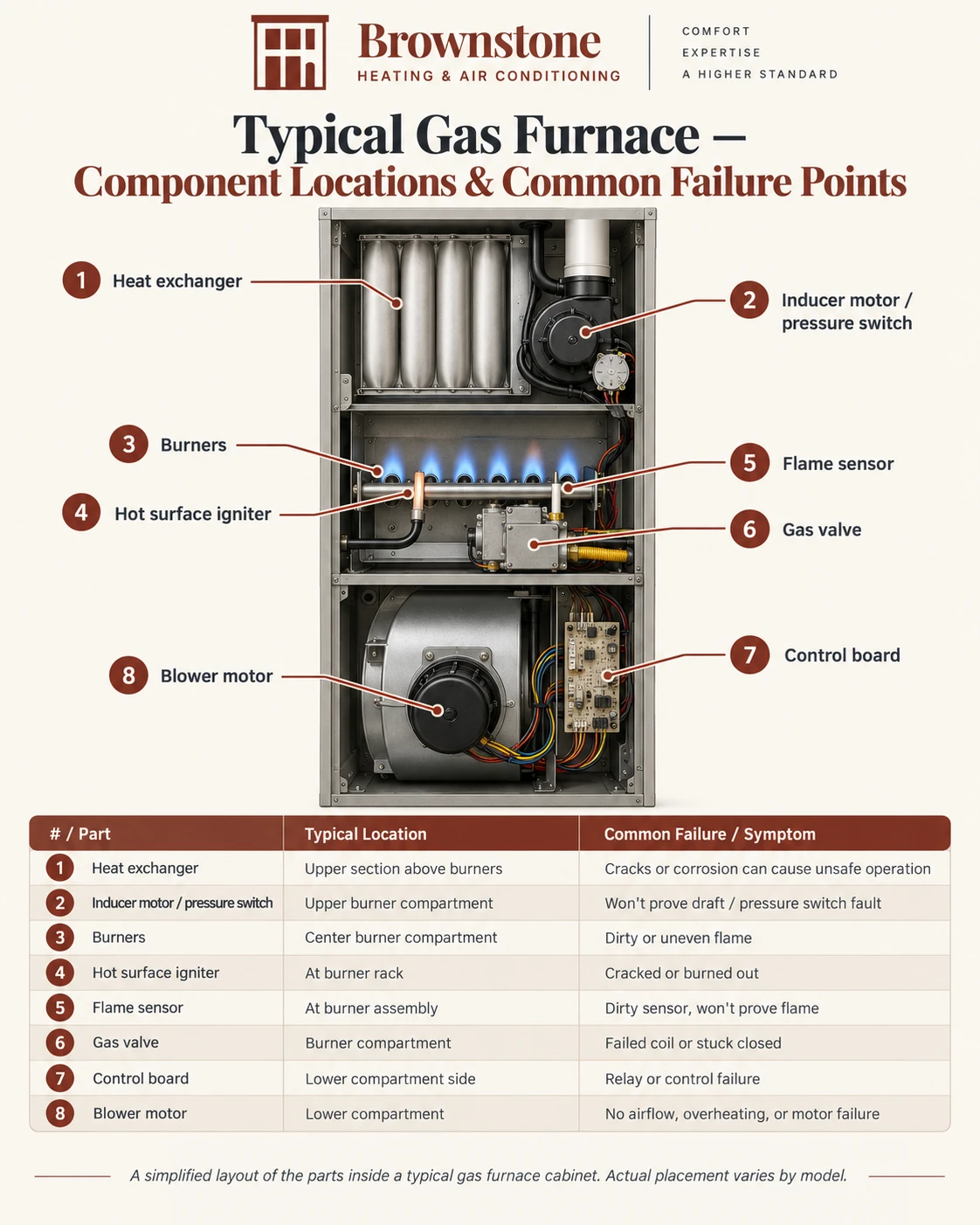
Anatomy of the system
Numbered parts below match the cost table further down — so you can see exactly where the failure usually sits.
Signs and symptoms
What to notice before calling a technician. The red callouts mean stop and call us immediately.
- 1
Thermostat, power, and gas
Before assuming a furnace failure, three basic things to notice by sight. These account for the #1 cause of unnecessary service calls.
What to notice
- Notice if the thermostat is set to HEAT and above room temperature
- Notice if the furnace switch (looks like a light switch on the side of the unit) is in the ON position
- Notice whether other gas appliances (stove burners) are working normally
Still not working? Call (347) 997-3360 — diagnostic visits are flat-rate, quoted before we start.
- 2
The normal ignition sequence
A furnace normally starts in stages: the draft system starts, the ignition sequence begins, the burners light, and then the blower starts moving heated air. If the furnace stops partway through that sequence, note what you heard or saw and tell the technician. The stopping point helps guide diagnosis, but it does not by itself prove which component failed.
What to notice
- Notice whether you hear the furnace begin a startup sequence
- Notice whether the burners ever light
- Notice whether the furnace starts briefly and then shuts itself down
Still not working? Call (347) 997-3360 — diagnostic visits are flat-rate, quoted before we start.
- 3
Notice if the air filter looks clogged
A heavily clogged filter can restrict airflow enough to contribute to overheating and safety shutdowns. If the filter is easily accessible, look at its condition, but do not open furnace panels or bypass a shutdown. Repeated shutdowns need professional diagnosis.
- 4
Smell gas? Stop everything.
Any smell of gas — even faint — means leave the building immediately.
Gas smell = evacuate, do not start the furnace
If you smell gas, leave the building and call the gas company's emergency line immediately — National Grid (1-718-643-4050) or 911 from outside, then call us at (347) 997-3360. Do not flip switches, do not restart the furnace, and do not attempt to locate or fix a gas leak yourself.
What this usually costs in Brooklyn
When a technician diagnoses the issue, here's the typical cost range for the repair. The exact number depends on parts, access, and how long it's been failing.
| Issue | Likely cause | Typical range |
|---|---|---|
| Clean flame sensor | Sooted sensor not proving flame | $150 – $400 |
| Replace hot surface ignitor | Ignitor cracked / burned out | $185 – $425 |
| Replace flame sensor | Sensor degraded beyond cleaning | $185 – $425 |
| Replace pressure switch | Switch won't prove draft | $275 – $550 |
| Replace inducer motor | Inducer fan failed | $550 – $950 |
| Replace gas valve | Valve stuck or coil failed | $475 – $1,100 |
| Replace control board | Board fault, no sequence | $550 – $1,200 |
Clean flame sensor
Sooted sensor not proving flame
$150 – $400
Replace hot surface ignitor
Ignitor cracked / burned out
$185 – $425
Replace flame sensor
Sensor degraded beyond cleaning
$185 – $425
Replace pressure switch
Switch won't prove draft
$275 – $550
Replace inducer motor
Inducer fan failed
$550 – $950
Replace gas valve
Valve stuck or coil failed
$475 – $1,100
Replace control board
Board fault, no sequence
$550 – $1,200
Typical range. Final cost confirmed on site after diagnosis.
Common Questions
Related Brooklyn HVAC services
- Furnace Repair Brooklyn — book a diagnosis
- HVAC Repair Brooklyn
- Goodman Furnace Error Codes
- Coleman Furnace Error Codes
- Boiler Not Heating — fixes
- Furnace Installation & Replacement Brooklyn
- Smart Thermostat Install — if the old thermostat is the culprit
- Heating Tune-Up — one visit, no contract
- HVAC Maintenance Plans
What to do next
Call (347) 997-3360 or book a diagnostic. Tell us what you observed — the sounds, the symptoms, when it started — and we'll know exactly what to check.
Do not attempt any repairs yourself. Gas, electrical, and refrigerant work requires an EPA-certified technician.
Need a Brooklyn tech today?
Same-day diagnostics when we can fit you in. Flat-rate visit, quoted before we start.
(347) 997-3360