AC Troubleshooting
AC Not Cooling in Brooklyn — Why & What to Do
System is humming, fan is blowing, but the apartment is still warm. In Brooklyn we see this on roughly half of all summer service calls — and the cause is almost always one of four things.
Anatomy of the system
Numbered parts below match the cost table further down — so you can see exactly where the failure usually sits.
- 1Indoor evaporator coil — frozen or dirty
- 2Refrigerant line-set joints — most common leak point
- 3Outdoor condenser — capacitor, contactor, or fan motor
- 4Schrader / service valve — slow refrigerant leak
Signs and symptoms
What to notice before calling a technician. The red callouts mean stop and call us immediately.
- 1
Thermostat — is it calling for cool?
When the thermostat is set to COOL and the temperature setting is below room temp, the outdoor unit should start within about 60 seconds. If nothing happens outside, the problem is usually electrical — a technician will check the thermostat wiring, control board, and contactor.
What to notice
- Notice if the thermostat display is on or blank
- Notice whether the outdoor fan is spinning
- Notice whether the indoor blower is running
Still not working? Call (347) 997-3360 — diagnostic visits are flat-rate, quoted before we start.
- 2
Look at the air filter and returns
Restricted airflow is a common reason an AC can run while producing weak cooling. A heavily clogged filter or blocked return can reduce airflow enough to affect performance and may contribute to coil icing.
What to notice
- Look at the filter — notice if it appears heavily clogged
- Notice whether furniture is blocking return grilles
- Notice whether any supply vents are closed off in the room
Still not working? Call (347) 997-3360 — diagnostic visits are flat-rate, quoted before we start.
- 3
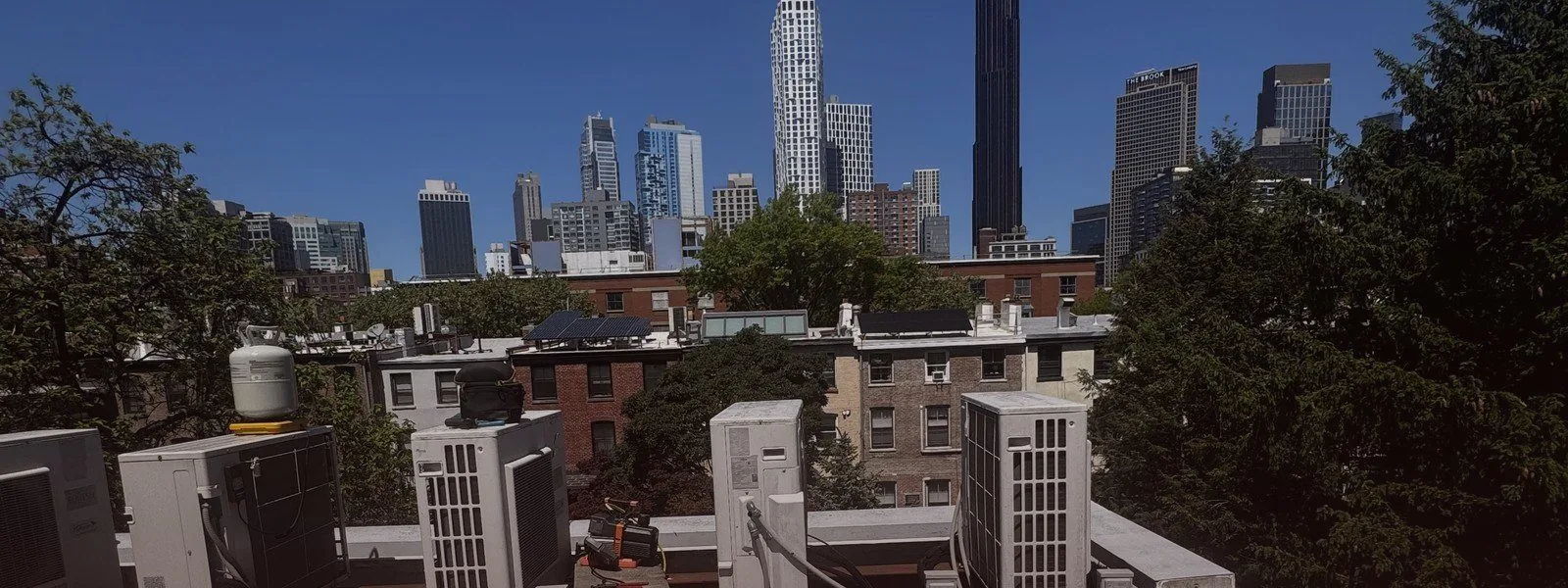
Observe the outdoor condenser from a safe distance
The big metal unit may be on the roof, in an alley, or beside the building. From a safe distance, notice whether the outdoor fan is running and whether the unit sounds different than usual. If the system is humming but the fan is not running, shut the system off and call for service. Several electrical or mechanical faults can cause this symptom, and the equipment should be tested before a component is replaced.
Do not touch a humming condenser
A humming condenser can be drawing abnormal current and continuing to run it may damage other components. Do not open the disconnect, electrical panel, or condenser cabinet. Shut the system off at the thermostat and call for diagnosis. - 4
Air temperature at the supply vents
Air coming from supply vents inside the home tells you what the system is actually producing. Cold, steady air means the system is working but may be undersized for the heat load. Warm or weak air points to a fault in the refrigerant cycle. A technician will measure the temperature split and pressures — do not touch refrigerant lines, the outdoor unit, or any electrical components.
What this usually costs in Brooklyn
When a technician diagnoses the issue, here's the typical cost range for the repair. The exact number depends on parts, access, and how long it's been failing.
| Issue | Likely cause | Typical range |
|---|---|---|
| Clear condensate drain | Backed-up drain pulling system off | $125 – $275 |
| Replace condensate pump | Failed pump on basement air handler | $225 – $425 |
| Replace capacitor | Compressor / fan won't start | $175 – $375 |
| Refrigerant recharge | Low charge from slow leak | $275 – $650 |
| Replace contactor | Pitted contactor not closing | $175 – $350 |
| Replace compressor | Compressor failure (older systems) | $950 – $2,400 |
Clear condensate drain
Backed-up drain pulling system off
$125 – $275
Replace condensate pump
Failed pump on basement air handler
$225 – $425
Replace capacitor
Compressor / fan won't start
$175 – $375
Refrigerant recharge
Low charge from slow leak
$275 – $650
Replace contactor
Pitted contactor not closing
$175 – $350
Replace compressor
Compressor failure (older systems)
$950 – $2,400
Typical range. Final cost confirmed on site after diagnosis.
Common Questions
What to do next
Call (347) 997-3360 or book a diagnostic. Tell us what you observed — the sounds, the symptoms, when it started — and we'll know exactly what to check.
Do not attempt any repairs yourself. Gas, electrical, and refrigerant work requires an EPA-certified technician.
Need a Brooklyn tech today?
Same-day diagnostics when we can fit you in. Flat-rate visit, quoted before we start.
(347) 997-3360